Best Sleep Clinics in the World 2026 Guide & How to Choose
The best sleep clinics in the world are not necessarily the ones with the biggest reputation; they are centers equipped to diagnose and treat your particular sleep disorder. Leading programs combine sleep specialists, sleep laboratories, polysomnography, behavioral medicine, sleep apnea care, and multidisciplinary expertise rather than offering one-size-fits-all solutions.
For someone exhausted after months of insomnia, waking repeatedly from snoring, or struggling with unexplained daytime sleepiness, finding the right clinic can feel surprisingly personal. Mayo Clinic, Stanford, Cleveland Clinic, Johns Hopkins, and international centers such as Memorial and Liv represent different models of sleep medicine. The right choice depends on diagnosis, testing needs, treatment options, accreditation, accessibility, insurance, and follow-up.
Best Sleep Clinics in the World: The State of Sleep Medicine in 2026
The best sleep clinics in the world increasingly approach sleep as a medical specialty rather than a simple complaint about tiredness. Modern sleep medicine covers insomnia, obstructive sleep apnea, narcolepsy, hypersomnia, parasomnias, restless legs syndrome, and circadian rhythm disorders, often requiring different specialists and diagnostic pathways.
The strongest programs tend to connect sleep medicine, neurology, pulmonology, psychiatry, psychology, pediatrics, ENT, dentistry, and behavioral sleep medicine. Stanford describes a multispecialty model spanning these disciplines, while Cleveland Clinic and Mayo likewise document multidisciplinary sleep teams. This matters because the right diagnosis determines which treatment makes sense.
A useful starting point is to separate three questions: What is wrong with my sleep? What testing can establish the cause? What treatments can this center actually provide? That simple framework prevents a famous hospital name from becoming a substitute for clinical fit.
Best Sleep Clinics in the World: Mayo Clinic The Gold Standard of Integrated Sleep Care
Mayo Clinic operates sleep-disorders centers across Minnesota, Arizona, and Florida, with specialists treating common, rare, and complex sleep disorders. Its care model brings together sleep medicine with neurology, pulmonology, psychiatry, psychology, pediatrics, ENT, dentistry, and related specialties. Its campuses’ sleep-disorders centers are accredited by the American Academy of Sleep Medicine.
Features and Specialties
Mayo’s documented sleep services span insomnia, sleep apnea, restless legs syndrome, narcolepsy, pediatric sleep disorders, sleep surgery, and complex conditions. The system also conducts sleep research and clinical trials. For a patient whose symptoms do not fit neatly into one diagnosis, multidisciplinary evaluation can be particularly relevant.
Pros and Cons
A major advantage is breadth: Mayo can connect sleep medicine with multiple medical specialties inside one health system. The trade-offs are practical rather than necessarily clinical travel may be required, appointments and insurance can vary by campus, and a highly specialized academic center may not be necessary for a straightforward case.
Who It Suits
Mayo can be particularly relevant when a patient has a complex, unusual, or multisystem sleep problem, needs multiple specialties, or wants evaluation within a large academic medical system. Someone with uncomplicated snoring may have other appropriate options closer to home, making diagnosis and treatment complexity important factors.
Best Sleep Clinics in the World: Stanford Center for Sleep Sciences Pioneers of Innovation
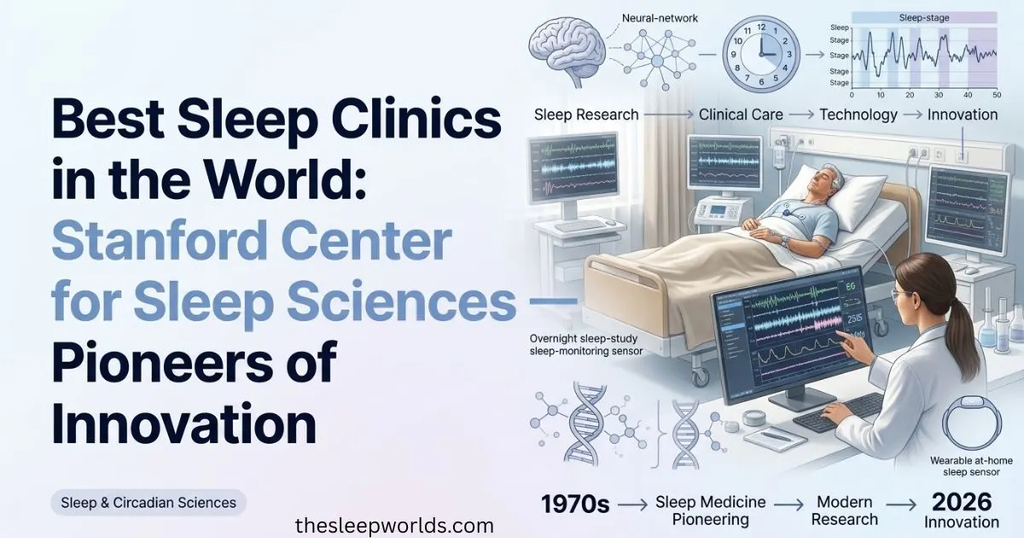
Stanford has unusually deep roots in modern sleep medicine. Stanford Health Care describes its Sleep Medicine Center as providing comprehensive care for adults and children, including insomnia, sleep apnea, and narcolepsy, alongside behavioral and medical treatments, clinical trials, specialty clinics, and a multidisciplinary team.
Stanford also highlights specialty clinics for insomnia, narcolepsy, parasomnias, and restless legs syndrome. Its sleep program combines clinical care with research, creating a useful model for patients whose conditions intersect with emerging therapies or clinical trials. That research connection is an important semantic distinction from a conventional community sleep laboratory.
Features and Specialties
Stanford’s documented capabilities include behavioral therapy, medications, devices, surgical procedures, clinical trials, and condition-specific specialty clinics. Stanford also identifies Emmanuel Mignot’s research as foundational to understanding narcolepsy. For patients with wakefulness disorders or unusual sleep conditions, research expertise can be a meaningful consideration.
Pros and Cons
The major strength of an academic center such as Stanford is the relationship between clinical care and research. The practical downside can be geography, appointment availability, and the fact that highly specialized services may be unnecessary for straightforward obstructive sleep apnea. Patients should match the center’s capabilities to the actual problem.
Who It Suits
Stanford may be particularly relevant for people seeking specialty evaluation, complex sleep-disorder care, pediatric or adult sleep medicine, behavioral treatment, or clinical-trial opportunities. Its role as a major sleep-research institution makes it especially interesting when standard evaluation has not fully explained persistent symptoms.
Best Sleep Clinics in the World: Cleveland Clinic Sleep Disorders Center Clinical Excellence
Cleveland Clinic’s Sleep Disorders Center is an AASM-accredited multispecialty program serving both children and adults. Its team includes specialists in neurology, internal medicine, family medicine, pediatrics, pulmonary medicine, psychiatry, psychology, and otolaryngology, creating a broad diagnostic and treatment network.
Its sleep-disorders services cover conditions including obstructive sleep apnea, insomnia, narcolepsy, hypersomnia, parasomnias, circadian-rhythm disorders, sleep-related movement disorders, and snoring. Cleveland Clinic also operates multiple sleep laboratories and offers home sleep apnea testing for selected patients.
Advanced Surgical Options
Sleep apnea treatment can extend beyond CPAP when appropriate. Cleveland Clinic’s broader sleep program connects sleep medicine with ENT and surgical expertise, which can matter for patients who have anatomical airway problems or cannot tolerate standard treatment. Surgical candidacy, however, depends on individual anatomy, diagnosis, and prior therapy.
The key lesson is that a “top” clinic should not simply offer many treatments; it should determine which treatment is appropriate. Polysomnography, home testing, airway evaluation, and specialist consultation may lead to very different pathways for two people who both report loud snoring.
Best Sleep Clinics in the World: Johns Hopkins Sleep Disorders Center Research-Driven Results
Johns Hopkins has operated sleep research and clinical programs since the 1970s and currently evaluates a broad range of conditions, including sleep-disordered breathing, narcolepsy, hypersomnia, insomnia, circadian rhythm disorders, parasomnias, and restless legs syndrome. Its physicians are certified in sleep medicine, and its laboratories provide multiple diagnostic procedures.
The center’s testing includes overnight polysomnography, CPAP and bilevel titration, multiple sleep latency testing, and maintenance of wakefulness testing. Johns Hopkins also offers behavioral sleep medicine for insomnia and conducts research through its sleep laboratory infrastructure, making its model particularly relevant to complex diagnostic questions.
Why You Should Consult Them
Johns Hopkins can be relevant when a patient needs broad sleep-disorder evaluation rather than a single-purpose apnea test. Its combination of sleep medicine, behavioral care, laboratory testing, research, and specialty evaluation illustrates why clinical capability should matter more than a generic “best clinic” label.
Best Sleep Clinics in the World: How to Choose the Right Clinic for Sleep Apnea Treatment 6 Insider Tips
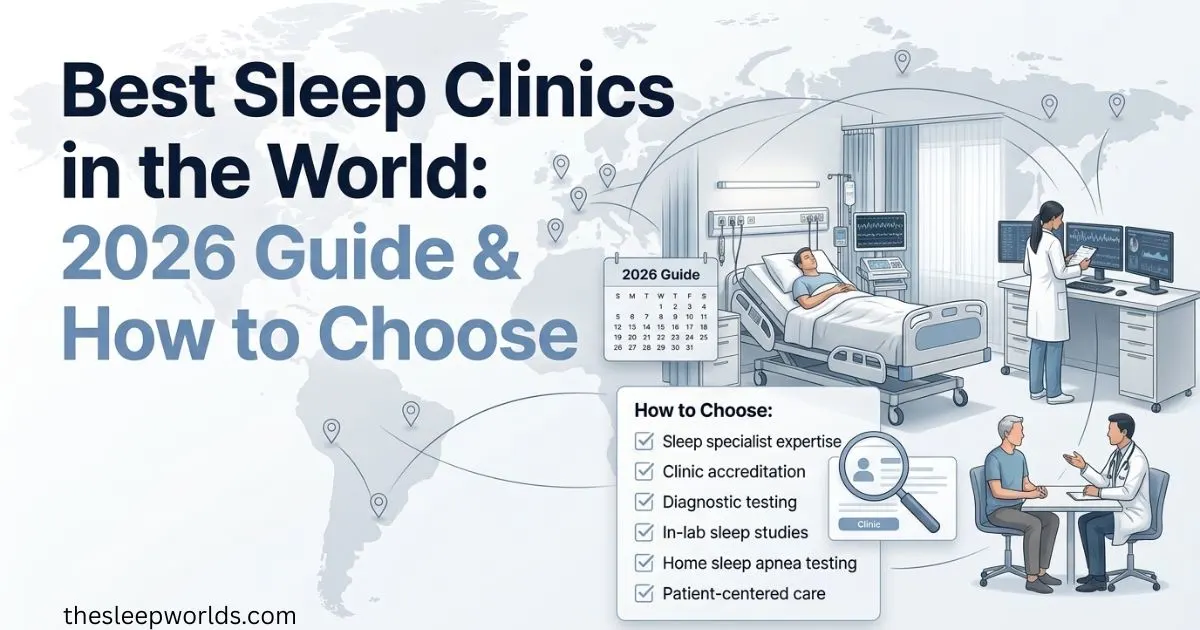
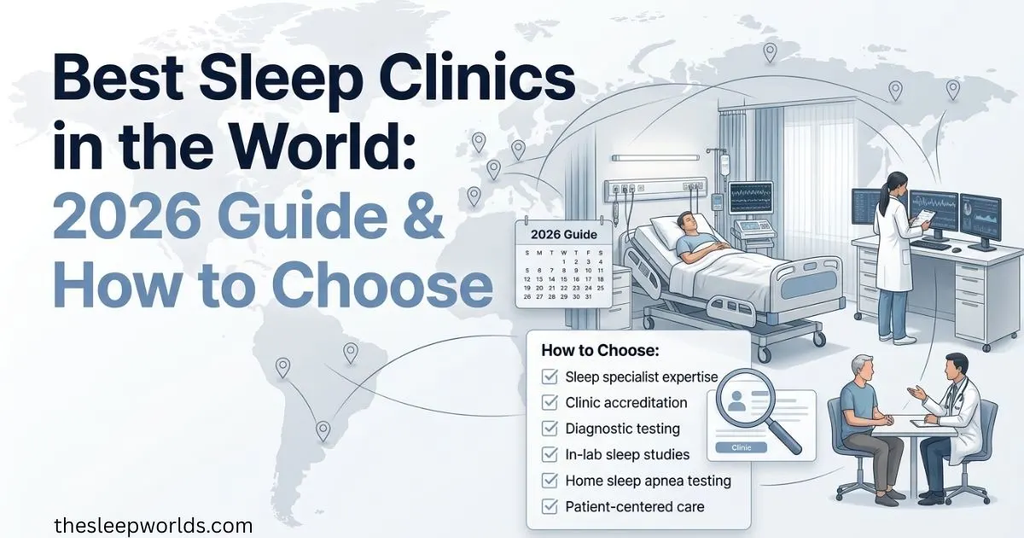
When comparing the best sleep clinics in the world, begin with your diagnosis rather than the hospital’s marketing. A person with suspected obstructive sleep apnea needs different testing from someone with narcolepsy, chronic insomnia, parasomnia, or unexplained daytime sleepiness. The right clinic is the one equipped for the question.
International clinics add another layer: accreditation, clinician qualifications, diagnostic equipment, treatment options, price transparency, language support, travel logistics, and follow-up after returning home. These factors appear repeatedly across the global competitors because medical care does not end when the plane lands back in the United States.
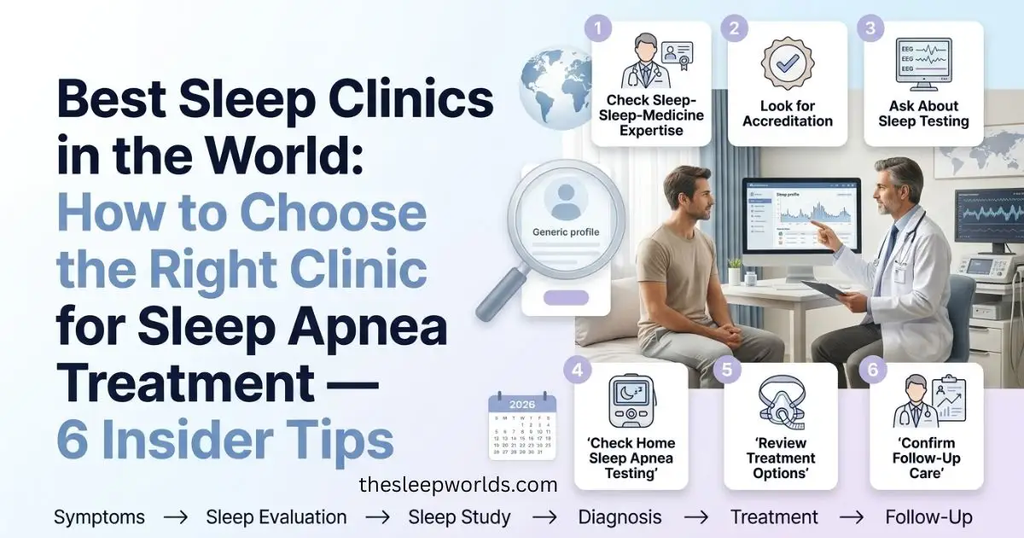
Check specialization
Look for a clinic with documented experience in your actual condition. Search for sleep apnea, insomnia, narcolepsy, hypersomnia, parasomnias, pediatric sleep medicine, or sleep surgery rather than relying on a broad “sleep clinic” label. Specialization becomes increasingly important when symptoms are unusual, severe, or resistant to first-line treatment.
Confirm diagnostic capabilities
Ask exactly which tests the clinic provides. Depending on symptoms, this may include polysomnography, home sleep apnea testing, actigraphy, MSLT, or maintenance of wakefulness testing. A clinic that cannot perform the necessary test may simply refer you elsewhere, adding time and cost to the diagnostic journey.
Compare treatment options
A comprehensive program should connect diagnosis with appropriate treatment rather than automatically recommending one device or medication. Depending on the condition, options may include CBT-I, PAP therapy, oral appliances, medication, behavioral treatment, light therapy, or surgery. Treatment should follow the diagnosis, not the other way around.
Ask about success rates
Be cautious with broad claims such as “highest success rate.” Ask whether outcomes are reported by diagnosis, severity, treatment type, patient population, and follow-up period. A clinic’s overall success number may tell you little about your specific condition. Transparent outcome definitions are more useful than an impressive percentage without context.
Review pricing details
International treatment quotes should separate consultation, diagnostic testing, treatment, hospital or laboratory fees, equipment, medications, travel-related services, and follow-up. A low advertised price can become much higher after exclusions. For U.S. patients, insurance network status and out-of-network reimbursement may also change the real cost substantially.
Read verified patient reviews
Reviews can help assess communication, scheduling, facilities, and patient experience, but they should not substitute for clinical evidence. Look for patterns from patients with similar diagnoses and treatment pathways. A handful of five-star comments cannot establish medical effectiveness, just as a single negative review cannot establish poor clinical care.
Best Sleep Clinics in the World: Diagnostic Technologies and Evaluation Criteria
Diagnostic technology is one of the clearest ways to distinguish a general sleep service from a comprehensive sleep-medicine center. Polysomnography, home sleep apnea testing, actigraphy, sleep logs, questionnaires, MSLT, and maintenance of wakefulness testing each answer different clinical questions. More technology is not automatically better; appropriate technology is.
For example, Mayo explains that polysomnography can record brain waves, blood oxygen, heart rate, breathing, eye movements, and leg movements, while actigraphy can track movement and sleep-wake patterns over several days or weeks. The correct test depends on the symptoms and suspected disorder.
1. Type 1 Polysomnography (In-Lab)
An overnight polysomnogram provides comprehensive physiological monitoring and can be useful when clinicians need information about brain activity, breathing, oxygen levels, heart rhythm, movements, and sleep architecture. It is especially important when a suspected disorder cannot be adequately characterized by a simpler home apnea test.
2. Type 4 Home Sleep Testing (HST)
Home sleep apnea testing can be convenient for selected patients with suspected obstructive sleep apnea. It is not a universal replacement for laboratory testing. Patients with complex symptoms, suspected narcolepsy, parasomnias, or other disorders may need a more comprehensive evaluation.
3. Actigraphy and Biomarkers
Actigraphy uses a wearable device to estimate sleep-wake patterns over time and can help clinicians understand circadian rhythm, sleep timing, and behavioral patterns. It is different from polysomnography and should not be treated as a universal diagnostic replacement. Its value comes from matching the measurement to the clinical question.
Evaluation Checklist for You
Before choosing a clinic, verify sleep-medicine accreditation, board-certified or appropriately credentialed specialists, required diagnostic tests, treatment options, insurance arrangements, follow-up procedures, and experience with your specific condition. For U.S. centers, the AASM maintains an accreditation-verification directory that lets patients check accredited facilities and the type of accreditation listed.
Best Sleep Clinics in the World: Costs, Insurance, and Accessibility in 2026
The price of sleep care can vary dramatically because “sleep clinic” may mean anything from a specialist consultation to an overnight polysomnogram, home sleep test, CBT-I program, CPAP setup, oral appliance, or surgery. International medical-tourism prices can also exclude travel, accommodation, translation, repeat testing, or follow-up.
For U.S. patients, insurance can be just as important as the sticker price. A clinic may be internationally renowned yet financially impractical if it is outside your network. Conversely, a nearby AASM-accredited center may provide the necessary diagnosis without international travel. The most sensible comparison is therefore total care pathway versus total cost, not advertised treatment price alone.
Accessibility also includes continuity. If you travel overseas for diagnosis or treatment, ask who will interpret follow-up studies, manage equipment, handle complications, and communicate with your U.S. physician afterward. A beautiful laboratory and impressive technology are less useful if you cannot obtain appropriate long-term care.
Conclusion
The phrase “best sleep clinics in the world” sounds like it should produce one definitive winner, but sleep medicine does not work that way. A center specializing in narcolepsy research may be a different fit from one with extensive sleep-apnea surgery, while a behavioral sleep clinic may be more appropriate for chronic insomnia.
The current evidence supports several major centers as important institutions to investigate. Mayo Clinic documents multidisciplinary sleep care and AASM-accredited sleep centers; Stanford Health Care documents comprehensive adult and pediatric care, specialty clinics, advanced treatments, and clinical trials; Cleveland Clinic documents AASM accreditation and multidisciplinary sleep care; and Johns Hopkins documents broad sleep testing and treatment capabilities.
Internationally, Memorial Hospitals Group operates a dedicated Sleep Disorder Center, while Liv Hospital documents polysomnography, home sleep apnea testing, MSLT, actigraphy, multidisciplinary evaluation, and international-patient support.
For Americans comparing providers, the most defensible starting point is diagnosis → specialist expertise → testing → treatment options → accreditation → cost → follow-up.
FAQs
What are the best sleep clinics in the world?
There is no universally applicable “best” sleep clinic. Major institutions such as Mayo Clinic, Stanford Health Care, Cleveland Clinic, and Johns Hopkins offer extensive sleep-medicine capabilities, while international centers provide additional options. The appropriate choice depends on the patient’s diagnosis, testing needs, treatment options, location, insurance, and follow-up requirements.
Which sleep clinic is best for complex sleep disorders?
Complex cases generally benefit from a multidisciplinary sleep-medicine center with access to multiple specialties and advanced diagnostic testing. Mayo, Stanford, Cleveland Clinic, and Johns Hopkins all document multidisciplinary sleep services, but individual suitability depends on the disorder and the treatment required.
What should I look for in a sleep clinic?
Look for appropriately credentialed sleep specialists, recognized accreditation, relevant diagnostic testing, evidence-based treatment options, transparent costs, and follow-up care. For U.S. facilities, the American Academy of Sleep Medicine provides an accreditation-verification directory.
Is AASM accreditation important?
AASM accreditation is a useful quality signal for U.S. sleep facilities because it verifies that a facility has been accredited for specified sleep-care services. The AASM directory allows users to verify active accreditation and its type.
What tests should a good sleep clinic offer?
Testing depends on the suspected disorder. Possible evaluations include polysomnography, home sleep apnea testing, actigraphy, multiple sleep latency testing, and maintenance of wakefulness testing. Johns Hopkins, for example, documents a broad laboratory-testing portfolio.
Is a home sleep apnea test as good as an in-lab sleep study?
They serve different purposes. Home sleep apnea testing can be appropriate for selected patients with suspected obstructive sleep apnea, whereas polysomnography provides much broader physiological information and may be needed for complex or non-apnea sleep disorders.
Which sleep clinic is best for insomnia?
For chronic insomnia, look for a center that provides Cognitive Behavioral Therapy for Insomnia (CBT-I) or behavioral sleep medicine rather than assuming medication is the only treatment. Johns Hopkins, for example, documents a behavioral medicine clinic for insomnia patients.
Which sleep clinic is best for sleep apnea?
A suitable sleep-apnea center should be able to diagnose the disorder accurately and provide an appropriate range of treatment options. Depending on the patient, this may include PAP therapy, oral appliances, behavioral measures, or surgical evaluation. Cleveland Clinic documents comprehensive sleep-disorder care and multiple diagnostic options.
Can I travel internationally for sleep treatment?
Yes, international sleep-medicine care exists, but travel should be evaluated carefully. Confirm clinician credentials, accreditation, diagnostic capabilities, total costs, language support, medical records, and post-treatment follow-up before traveling. Global directories such as MyMediTour specifically emphasize these considerations.
What is the most important factor when choosing a sleep clinic?
The most important practical factor is clinical fit: whether the clinic has the expertise and diagnostic tools needed for your particular sleep problem. Reputation can help create a shortlist, but diagnosis-specific expertise, appropriate testing, evidence-based treatment, accreditation, and continuity of care provide more actionable information.
That approach produces a much more meaningful shortlist than a generic internet ranking.
Related Articles

Ryan Foster is a curious and dedicated professional with an interest in digital content, lifestyle, and online research. He enjoys exploring useful ideas, learning about new topics, and sharing practical information with others. Ryan values continuous learning, creativity, and building meaningful connections through the digital world.