World Record No Sleep Longest Time Without Sleeping
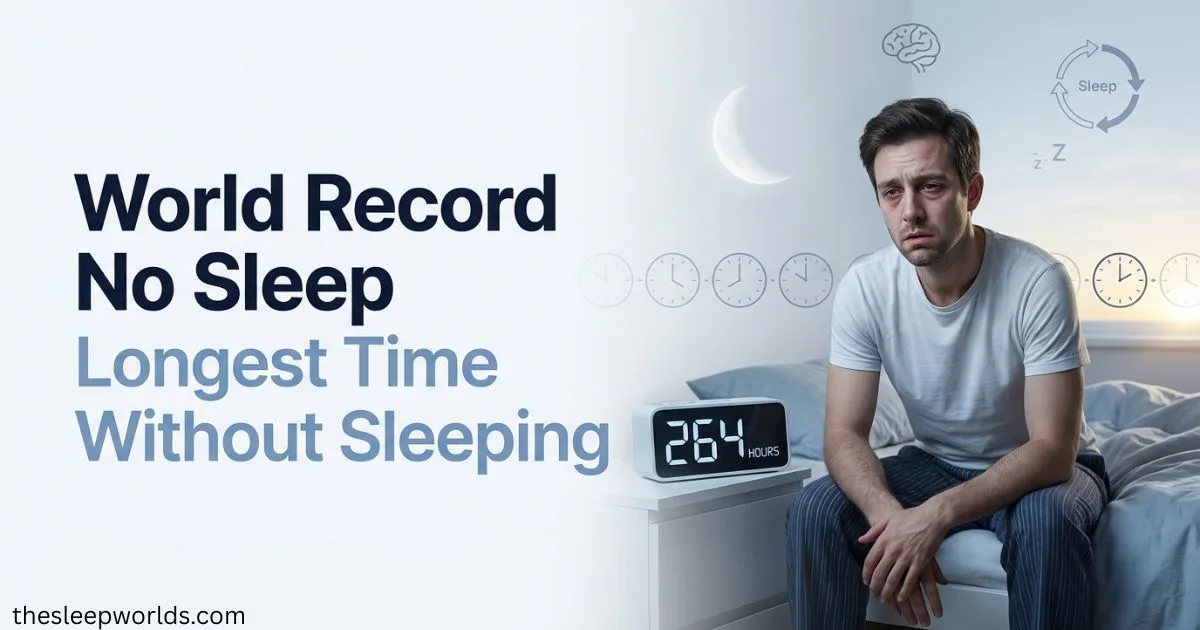
The last Guinness-recognized world record for no sleep was 453 hours and 40 minutes 18 days, 21 hours and 40 minutes set by Robert McDonald in 1986. Guinness stopped monitoring the category in 1997 because prolonged sleep deprivation is inherently dangerous. The famous Randy Gardner experiment, meanwhile, documented approximately 264 hours of wakefulness under close observation.
That distinction matters because online articles often mix official records, closely monitored experiments, and self-reported challenges into one number. After researching the historical record and modern sleep science, the picture is more complicated: microsleeps can occur without a person realizing it, making absolute wakefulness difficult to prove.
World Record No Sleep: Guinness World Records of Sleep Deprivation
Guinness World Records stopped monitoring the longest-time-awake category in 1997. The last Guinness-recognized record belonged to Robert McDonald, who stayed awake for 453 hours and 40 minutes in 1986. That equals 18 days, 21 hours and 40 minutes far beyond the better-known Randy Gardner experiment.
The important qualification is that Guinness does not currently maintain an active record for longest continuous wakefulness. Therefore, claims that someone today “holds the official world record” should be checked carefully. Guinness itself says the category was discontinued because of the inherent dangers associated with extreme sleep deprivation.
Who was Randy Gardner?
Randy Gardner was a 17-year-old California high-school student who attempted to stay awake for a science-fair project in 1964. He reached approximately 264 hours, or about 11 days, while being observed by researchers including Stanford sleep researcher William Dement and health monitor John Ross.
Gardner’s case remains unusually important because it was extensively documented. Researchers observed changes in his analytical ability, perception, motivation, memory and motor control, while Ross reported hallucinations, delusions and an extremely short attention span by around the fourth day.
World Record No Sleep: A Timeline of Record-Breakers and the Effects They Suffered
The history of sleep-deprivation records stretches across several decades. Guinness describes attempts involving radio personalities, students and stunt performers, with reported wakefulness gradually increasing from roughly eight days in the late 1950s to more than 18 days in the 1980s. The records also became progressively difficult to verify scientifically.
The timeline is useful because it shows why simply searching for “longest time without sleep” can produce different answers. Randy Gardner’s 1964 experiment was closely monitored, while later record claims had different circumstances. Guinness ultimately discontinued the category rather than encouraging people to push the boundary further.
1950s
In 1959, radio personalities including Peter Tripp and Dave Hunter attempted prolonged wakefulness. Tripp eventually experienced serious psychological symptoms, including hallucinations, delusions and paranoia, while Hunter reportedly reached 225 hours. Tom Rounds later raised the record to 260 hours that same year.
1960s
Randy Gardner reached 264 hours in 1964, but his record was subsequently surpassed. Guinness records later describe Jim Thomas at 266 hours 30 minutes, Toimi Silvo at 276 hours, Charles E. Christensen at a higher duration, and Bertha Van Der Merwe at 282 hours 55 minutes in 1969.
1970s
Roger Guy English reportedly remained awake for 288 hours in 1974, while Maureen Weston later reached 449 hours during a rocking-chair marathon in 1977. Guinness notes that Weston experienced hallucinations toward the end of the attempt, highlighting the physiological cost of extreme sleep deprivation.
1980s
Robert McDonald surpassed Weston’s figure in 1986, recording 453 hours and 40 minutes. His attempt took place during a rocking-chair marathon, and he reported difficulty keeping food down, weight loss and memory problems as the attempt progressed. This became the final Guinness-recognized record before the category was discontinued.
World Record No Sleep: The Effects of Sleep Deprivation
Sleep deprivation affects much more than feeling tired. Modern evidence links insufficient sleep with impaired attention, slower reactions, reduced decision-making ability, memory problems and changes in mood. Live Science reports that after 24 hours awake, measurable impairment can become substantial, while longer deprivation can produce hallucinations and difficulty with executive function.
The American Academy of Sleep Medicine describes sleep as essential to health, well-being and public safety. Healthy sleep involves more than simply accumulating hours; adequate duration, quality, appropriate timing, regularity and the absence of untreated sleep disorders all matter.
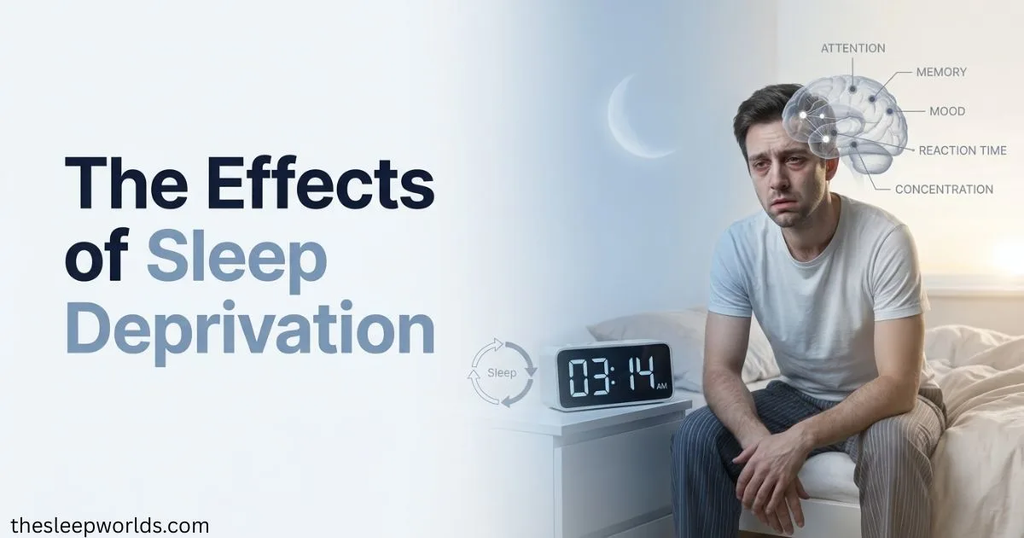
What happens during prolonged wakefulness?
As wakefulness continues, the brain builds increasing pressure to sleep. One particularly important phenomenon is microsleep brief, involuntary episodes in which the brain partially enters sleep even though a person may appear awake. These episodes can happen without conscious awareness and can be dangerous during driving or other critical tasks.
This helps explain one of the biggest problems with historical sleep records. A person can believe they remained continuously awake while experiencing extremely brief sleep intrusions. Without continuous physiological monitoring, proving absolute wakefulness over hundreds of hours is extraordinarily difficult.
World Record No Sleep: Other Reasons Why We No Longer Monitor This Record
Microsleeps are one reason the record became difficult to verify, but safety is the larger issue. Guinness explains that the category was discontinued because of the inherent dangers associated with sleep deprivation. The historical attempts demonstrate why deliberately extending wakefulness for entertainment or competition carries significant risks.
Modern sleep experts also emphasize that people may underestimate their own impairment. The NIH explains that people experiencing sleep deficiency may not recognize how compromised their attention and performance have become. Microsleep can occur without awareness, creating particular risks when someone is driving or operating machinery.
World Record No Sleep: The Human Limit
There is no scientifically established number that represents the absolute maximum time a healthy human can remain continuously awake. Guinness specifically says that determining the true human limit is difficult because historical attempts cannot reliably account for microsleeps.
The distinction between a recorded observation and a biological maximum is crucial. Robert McDonald’s 453-hour Guinness record tells us the longest duration Guinness recognized; it does not prove that humans can consciously remain completely awake for exactly that amount of time without any microscopic sleep episodes.
Why can’t science simply test the limit?
A controlled experiment deliberately keeping people awake until serious physiological deterioration would raise major ethical problems. Live Science notes that prolonged sleep deprivation is so harmful that it cannot ethically be studied in humans in the same way as ordinary laboratory variables.
Researchers instead learn from shorter controlled periods, historical cases and naturally occurring sleep disorders. This produces useful information about attention, cognition, metabolism and health without requiring scientists to deliberately push healthy volunteers toward an extreme physiological boundary.
World Record No Sleep: Tony Wright’s Preparation
Tony Wright became notable in 2007 after attempting to stay awake for more than 11 days. HowStuffWorks reports that Wright had previously conducted numerous personal sleep-deprivation experiments and used a raw-food diet during the attempt. He claimed his approach helped him remain alert, although his theories were not accepted as established sleep science.
Wright’s story is important because it illustrates the difference between a self-reported attempt and an independently verified record. HowStuffWorks notes that Guinness no longer recognized sleep-deprivation attempts, while Wright’s own experience included symptoms such as hallucinations and difficulty processing information.
World Record No Sleep: Monitoring the Sleep Experiment
Randy Gardner’s experiment stands apart from many later internet claims because researchers directly observed him. William Dement monitored Gardner during the final portion of the attempt, while John Ross had previously documented significant behavioral and cognitive changes. The experiment therefore provides unusually detailed historical evidence about extreme wakefulness.
Even Gardner’s case demonstrates the limitations of measuring “no sleep.” Guinness reports that Dement later accepted Gardner may have experienced microsleeps despite being under close supervision. That possibility makes the phrase “264 hours without sleep” better understood as a documented period of attempted continuous wakefulness rather than proof of absolutely zero sleep at every second.
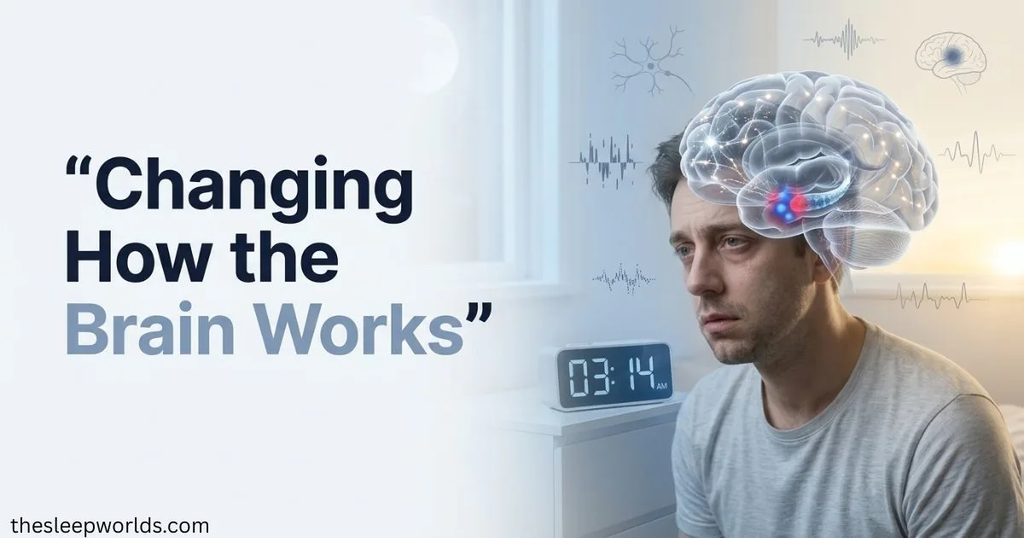
World Record No Sleep: Changing How The Brain Works
Sleep deprivation changes the brain’s ability to sustain attention and perform complex tasks. Gardner showed problems involving analytical ability, perception, motivation, memory and motor control, while modern research confirms that increasing sleep pressure can produce lapses in attention and microsleep.
The brain also does not simply remain in a normal waking state as fatigue accumulates. Live Science reports that sleep intrusion can occur around prolonged wakefulness, with people appearing awake while experiencing brief abnormal sleep-like episodes. That is one reason extreme wakefulness cannot be treated as a simple test of willpower.
World Record No Sleep: Drunk with Tiredness
Sleep loss can significantly impair performance. Live Science reports research showing that 24 hours of wakefulness can produce hand-eye coordination impairment comparable to a blood alcohol concentration of 0.1%, alongside slower reaction time, impaired decision-making, memory and attention problems, irritability, and sensory changes.
The safety implication is especially important. Sleep-deprived people may feel capable of continuing normally even while their attention is deteriorating. NIH guidance notes that sleep deficiency can cause microsleeps and impair driving ability, making “I feel okay” an unreliable test of whether someone is safe to drive.
World Record No Sleep: High Blood Pressure, Stress, and Low Oxygen Levels
Long-term insufficient sleep is associated with broader health concerns involving cardiovascular, metabolic and mental health. The American Academy of Sleep Medicine identifies insufficient sleep and untreated sleep disorders as detrimental to physical health, mental health, well-being and public safety.
Current U.S. data show why sleep health matters beyond unusual record attempts. The CDC’s 2024 National Health Interview Survey found that 30.5% of U.S. adults slept fewer than seven hours on average in a 24-hour period. The same report found 15.4% had trouble falling asleep and 18.1% had trouble staying asleep most days or every day.
The difference between an extreme record and everyday sleep loss
A person does not need to approach a historical record before sleep loss becomes meaningful. Repeatedly getting too little sleep can affect attention, mood, health and safety, while severe sleep deprivation can produce microsleeps and major cognitive impairment. The CDC recommends that adults generally get at least seven hours daily.
This is why the historical records are better viewed as cautionary scientific stories than challenges to reproduce. The fascinating question is not how long someone can force themselves to stay awake, but what those cases have taught researchers about the essential biological role of sleep.
A note about recent online “no-sleep records”
Social-media and livestream challenges have generated claims of new no-sleep records, including attempts to exceed Randy Gardner’s famous duration. However, these claims should not be confused with a current Guinness title because Guinness discontinued the category. The absence of official monitoring makes independent verification particularly difficult.
For SEO and factual accuracy, an article should therefore distinguish Guinness-recognized records, medically monitored experiments, reported attempts, and self-reported livestream challenges rather than placing all four into one “world record” category.
Conclusion
The world record no sleep story has no single simple number. Guinness’s last recognized record was Robert McDonald’s 453 hours 40 minutes in 1986, while Randy Gardner’s approximately 264-hour experiment remains one of the most extensively documented cases of prolonged human wakefulness. Guinness stopped monitoring the category in 1997 because of safety concerns.
The deeper lesson is that extreme wakefulness is not simply a test of determination. Microsleeps, impaired attention, hallucinations, cognitive changes and other effects make prolonged sleep deprivation both dangerous and difficult to measure precisely. Modern health authorities emphasize adequate, regular sleep rather than attempting to extend wakefulness.
FAQs
What is the world record for no sleep?
The last Guinness-recognized record for the longest time awake was 453 hours 40 minutes, or 18 days 21 hours 40 minutes, achieved by Robert McDonald in 1986. Guinness stopped monitoring the category in 1997.
Who holds the record for staying awake the longest?
Robert McDonald holds the last Guinness-recognized record, at 453 hours 40 minutes. Randy Gardner is the better-known scientifically documented case, having remained awake for approximately 264 hours in 1964 under close observation.
How many days is 453 hours and 40 minutes?
453 hours and 40 minutes equals 18 days, 21 hours and 40 minutes.
How long did Randy Gardner stay awake?
Randy Gardner stayed awake for approximately 264 hours, or about 11 days. Guinness documents his 1964 attempt and the cognitive and behavioral effects observed during it.
Does Guinness still recognize the no-sleep record?
No. Guinness stopped monitoring the longest-time-awake category in 1997, citing the inherent dangers of sleep deprivation.
Did Tony Wright break the world record?
Tony Wright claimed an 11-day-plus wakefulness attempt in 2007, but his attempt should not be described as a current official Guinness record. Guinness had already stopped monitoring the category because of safety concerns.
What happens after 24 hours without sleep?
After about 24 hours awake, people can experience impaired reaction time, attention, memory, decision-making, coordination and mood. Research cited by Live Science found hand-eye coordination impairment comparable to a 0.1% blood alcohol concentration.
Can you really stay awake for weeks?
Historical reports describe extremely long periods of attempted wakefulness, but continuous wakefulness is difficult to verify because microsleeps can occur without the person realizing it. Guinness says this makes the true biological limit difficult to determine.
What is a microsleep?
A microsleep is a brief, involuntary episode of sleep that can occur during wakefulness. The person may appear awake but temporarily stop processing information normally. Microsleeps are particularly dangerous during driving or other activities requiring sustained attention.
Is it dangerous to try to break the no-sleep record?
Yes. Extreme sleep deprivation can cause serious impairment, microsleeps, hallucinations and other health and safety problems. Guinness discontinued the category partly because of these dangers. Attempting prolonged wakefulness as a personal challenge is not medically advisable.
How much sleep do adults need?
The CDC recommends at least seven hours per day for adults ages 18–60, with different recommendations for older adults. Sleep quality and regularity also matter, not just the number of hours.

Rayan Foster is a curious and dedicated professional with an interest in digital content, lifestyle, and online research. He enjoys exploring useful ideas, learning about new topics, and sharing practical information with others. Rayan values continuous learning, creativity, and building meaningful connections through the digital world.