World Sleep Congress 2025 Alkermes Presentations Results, Studies & Key Findings
The World Sleep Congress 2025 Alkermes presentations centered on alixorexton, an investigational oral orexin 2 receptor agonist studied in narcolepsy type 1, with additional work addressing idiopathic hypersomnia. The Singapore meeting featured three Alkermes oral presentations from Vibrance-1 and a Vibrance-3 study-design poster.
For readers following sleep medicine research, the important story is broader than presentation titles. The data covered wakefulness, excessive daytime sleepiness, fatigue, cognition, cataplexy, patient-reported outcomes, safety, and orexin biology. This guide brings those pieces together while distinguishing 2025 conference findings from the program’s subsequent 2026 clinical-development milestones.

World Sleep Congress 2025 Alkermes Presentations: Oral presentations
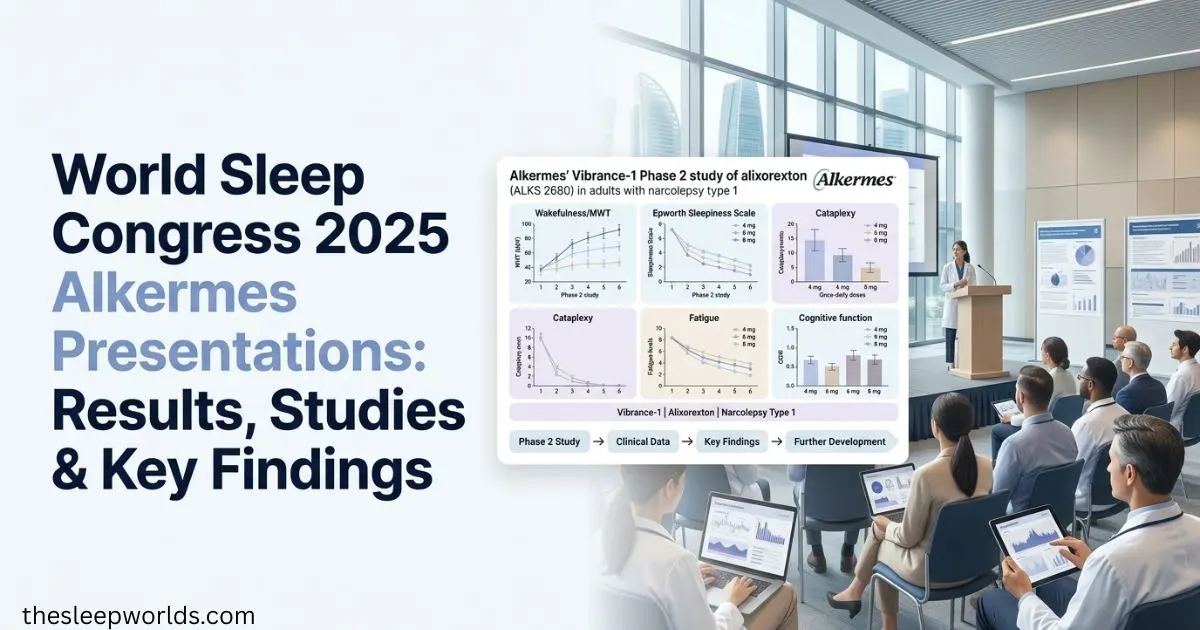
The three principal World Sleep Congress 2025 Alkermes presentations came from Vibrance-1, a randomized, double-blind, placebo-controlled phase 2 study in 92 adults with narcolepsy type 1. The presentations examined alixorexton’s effects on wakefulness, narcolepsy symptoms, fatigue, and patient-reported cognitive functioning.
Giuseppe Plazzi presented the main Vibrance-1 study; Yves Dauvilliers presented findings on narcolepsy symptoms and fatigue; Plazzi also presented the patient-reported cognition analysis. The presentations were part of the September 8 session “Targeting the orexin pathway: Emerging pharmacotherapies for narcolepsy type 1.”
Vibrance-1: A Randomized Phase 2 Study Evaluating Safety and Efficacy of the Orexin 2 Receptor Agonist Alixorexton (ALKS 2680) in Patients with Narcolepsy Type 1
The primary presentation examined once-daily alixorexton at 4 mg, 6 mg, and 8 mg versus placebo. Alkermes reported statistically significant improvements in mean sleep latency on the Maintenance of Wakefulness Test at week six, with observed mean latencies of approximately 24, 26, and 28 minutes across the three active-dose groups.
Improvement in the Severity of Narcolepsy Symptoms and Fatigue in Patients with Narcolepsy Type 1 Treated with the Orexin 2 Receptor Agonist Alixorexton (ALKS 2680)
The second presentation focused on disease severity and fatigue. Alkermes reported improvements in the Epworth Sleepiness Scale and exploratory measures including PROMIS-Fatigue and the Narcolepsy Severity Scale. These were company-reported clinical-trial findings and should not be interpreted as evidence that alixorexton is an approved treatment.
Improvement in Patient-reported Cognitive Functioning in Patients with Narcolepsy Type 1 Treated with the Orexin 2 Receptor Agonist Alixorexton (ALKS 2680)
The third oral presentation examined patient-reported cognition. Alkermes reported statistically significant improvements from baseline versus placebo on the British Columbia Cognitive Complaints Inventory. The analysis is notable because cognitive difficulties and fatigue can contribute substantially to the everyday burden experienced by people with narcolepsy.
World Sleep Congress 2025 Alkermes Presentations: Poster Presentation
The Alkermes poster program extended beyond narcolepsy type 1. A separate Vibrance-3 poster described the design and methods of a randomized, placebo-controlled phase 2 study evaluating alixorexton in adults with idiopathic hypersomnia. Marcus Yountz of Alkermes was listed as the presenter, with poster board 169 scheduled for September 9.
Vibrance-3 matters because the alixorexton development strategy was not limited to narcolepsy type 1. Alkermes was simultaneously studying the orexin 2 receptor approach across narcolepsy type 1, narcolepsy type 2, and idiopathic hypersomnia, three disorders characterized by clinically important problems involving sleepiness or wakefulness.

A Phase 2, Randomized, Placebo-Controlled, Parallel-Group Study Evaluating the Safety and Efficacy of Alixorexton (ALKS 2680) in Patients With Idiopathic Hypersomnia: Study Design and Methods for Vibrance-3
Unlike the Vibrance-1 presentations, the World Sleep 2025 Vibrance-3 material was about study design and methods, not a completed efficacy dataset. That distinction is important for interpreting conference coverage: a study-design poster tells readers how a trial is being conducted, while a results presentation reports findings from participants already evaluated.
The Alkermes Medical Affairs page lists Vibrance-3 under sleep-wake disorders and provides access to the poster. The company identifies alixorexton as investigational, meaning safety and effectiveness have not been established for an approved indication.
World Sleep Congress 2025 Alkermes Presentations: Conference Call and Webcast
The World Sleep Congress 2025 Alkermes presentations were followed by an investor webcast and conference call on September 8, 2025. The company provided accompanying slides for analysts and investors, allowing the conference findings to be discussed alongside the detailed Vibrance-1 dataset and clinical-development plans.
For U.S. readers, the scheduled webcast was particularly useful because the event took place in Singapore. Alkermes announced the presentation for 8:00 a.m. Eastern Time, corresponding to 8:00 p.m. Singapore time. The company said a replay would be archived for 30 days after the presentation.
The investor materials should be read differently from an independent medical review. Alkermes is the sponsor developing alixorexton, so its presentation naturally emphasizes the investigational drug’s clinical findings and development program. For balanced interpretation, readers should also consider the trial design, endpoints, statistical results, safety information, regulatory status, and later peer-reviewed evidence.
World Sleep Congress 2025 Alkermes Presentations: About the Vibrance-1 Phase 2 Study (NCT06358950)
Vibrance-1 enrolled 92 adults with narcolepsy type 1 and randomized participants to once-daily alixorexton at 4 mg, 6 mg, or 8 mg, or placebo. The randomized double-blind treatment period lasted six weeks, followed by an open-label safety extension and longer-term safety follow-up for eligible participants.
The primary endpoint assessed change in mean sleep latency on the Maintenance of Wakefulness Test at week six. Key secondary measures included the Epworth Sleepiness Scale and weekly cataplexy rate, while exploratory patient-reported outcomes examined disease severity, fatigue, and cognition.
| Vibrance-1 measure | Reported World Sleep 2025 finding |
| Participants | 92 adults with NT1 |
| Active doses | 4 mg, 6 mg, 8 mg |
| Treatment | Once daily |
| Primary measure | Mean sleep latency on MWT |
| 4 mg MWT result | Approximately 24 minutes |
| 6 mg MWT result | Approximately 26 minutes |
| 8 mg MWT result | Approximately 28 minutes |
| Key secondary measure | Epworth Sleepiness Scale |
| Additional measure | Weekly cataplexy rate |
| Exploratory measures | Fatigue, cognition, disease severity |
| Study period | Six-week double-blind period |
The company reported that all three alixorexton dose groups achieved mean sleep latency of at least 20 minutes on the MWT, which Alkermes described as normative wakefulness. It also reported improvements in ESS and exploratory patient-reported outcomes, while noting that alixorexton remained an investigational medicine.
World Sleep Congress 2025 Alkermes Presentations: About Alixorexton
Alixorexton, formerly called ALKS 2680, is an investigational oral selective orexin 2 receptor (OX2R) agonist. The scientific rationale is tied to orexin biology: orexin signaling is involved in maintaining wakefulness, making the pathway relevant to disorders characterized by excessive daytime sleepiness and impaired wakefulness.
At World Sleep 2025, the drug was being evaluated through the Vibrance program in NT1, NT2, and idiopathic hypersomnia. The 2025 presentation materials emphasized once-daily dosing and the potential of targeting OX2R across central disorders of hypersomnolence.
It is important not to confuse encouraging phase 2 findings with regulatory approval. The World Sleep presentation document explicitly stated that alixorexton had not been approved by the FDA or another health authority and that its safety and efficacy had not been established. That regulatory distinction remains essential when discussing an investigational therapy.
By 2026, the development program had advanced substantially. Alkermes initiated the phase 3 Brilliance program in April 2026 for narcolepsy type 1 and type 2. In January 2026, the FDA had granted Breakthrough Therapy designation for alixorexton in NT1, while a June 2026 FDA record shows orphan-drug designation for idiopathic hypersomnia not approval.

World Sleep Congress 2025 Alkermes Presentations: Scientific Program Highlights
World Sleep Congress 2025 took place September 5–10, 2025, at the Suntec Singapore Convention and Exhibition Centre. The World Sleep Society reports that more than 4,100 people from more than 80 countries attended, with more than 350 hours of in-person programming covering basic science, clinical research, public health, technology, education, and related disciplines.
That broader context explains why the Alkermes presentations attracted attention. The congress was not simply a pharmaceutical showcase; it was a multidisciplinary scientific meeting where researchers, clinicians, educators, technologists, industry participants, and advocates shared emerging sleep and circadian-health research.
The official World Sleep retrospective describes the 2025 scientific program as including keynote lectures, scientific symposia, oral abstracts, poster sessions, and continuing-education courses. Alkermes’ alixorexton presentations therefore sat within a much larger research environment focused on sleep medicine and circadian health.
World Sleep Congress 2025 Alkermes Presentations: World Sleep 2025 Recordings
The World Sleep Society recorded hundreds of hours of presentations from Singapore. Its retrospective says that recorded sessions are available through the Society’s Learning Center, with attendees receiving complimentary access and other viewers able to purchase recordings individually or through program bundles.
For someone researching the World Sleep Congress 2025 Alkermes presentations, the official congress Learning Center and Alkermes Medical Affairs resource page are therefore more useful than relying solely on third-party summaries. The Alkermes page specifically provides the selected presentations, poster, and audio abstracts.
The recordings also provide useful context that a short press release cannot capture. A presentation can reveal the endpoint definitions, participant characteristics, statistical methods, adverse-event information, and limitations behind a headline result. That distinction is particularly important in clinical-trial reporting, where a single efficacy number rarely tells the entire scientific story.
Conclusion
The World Sleep Congress 2025 Alkermes presentations were centered on the phase 2 Vibrance-1 program for alixorexton in narcolepsy type 1, with three oral presentations covering safety and efficacy, narcolepsy symptoms and fatigue, and patient-reported cognition. Alkermes also presented the Vibrance-3 study design for idiopathic hypersomnia.
The most important scientific details were the randomized placebo-controlled design, 92-person NT1 population, once-daily 4 mg/6 mg/8 mg dosing, MWT wakefulness results, ESS findings, cataplexy analysis, and patient-reported fatigue and cognitive outcomes. Alixorexton remained investigational at the time of the congress.
The story has continued since then. In 2026, Alkermes moved alixorexton into phase 3 for NT1 and NT2, while FDA Breakthrough Therapy and orphan-drug designations were granted for specified indications. These developments are important follow-up context, but they do not mean the drug has received FDA approval.
FAQs
What did Alkermes present at World Sleep Congress 2025?
Alkermes presented three oral analyses from the Vibrance-1 phase 2 study of alixorexton in narcolepsy type 1. It also presented a poster describing the Vibrance-3 phase 2 study design for idiopathic hypersomnia.
What is alixorexton?
Alixorexton, formerly known as ALKS 2680, is an investigational oral selective orexin 2 receptor agonist being developed for narcolepsy type 1, narcolepsy type 2, and idiopathic hypersomnia. It is not an FDA-approved medicine.
What was Vibrance-1?
Vibrance-1 was a randomized, double-blind, placebo-controlled phase 2 study involving 92 adults with narcolepsy type 1. Participants received 4 mg, 6 mg, or 8 mg of alixorexton or placebo once daily for six weeks.
What did the World Sleep 2025 Vibrance-1 results show?
Alkermes reported dose-dependent improvements in mean sleep latency on the Maintenance of Wakefulness Test, with approximate mean latencies of 24, 26, and 28 minutes for the 4 mg, 6 mg, and 8 mg groups, respectively. The company also reported improvements in ESS, cataplexy, fatigue, cognition, and disease severity.
Who presented the Alkermes World Sleep 2025 data?
Giuseppe Plazzi presented the main Vibrance-1 study and patient-reported cognitive-functioning analysis. Yves Dauvilliers presented the narcolepsy-symptom and fatigue analysis. Marcus Yountz presented the Vibrance-3 study-design poster.
What was the Vibrance-3 presentation about?
Vibrance-3 was a phase 2 randomized, placebo-controlled study evaluating the safety and efficacy of alixorexton in adults with idiopathic hypersomnia. The World Sleep 2025 poster focused on the study’s design and methods rather than presenting a completed efficacy dataset.
Was alixorexton approved by the FDA at World Sleep 2025?
No. At the 2025 congress, alixorexton was investigational. In January 2026, the FDA granted Breakthrough Therapy designation for alixorexton in narcolepsy type 1, but that designation is not FDA approval.
Is alixorexton still being studied in 2026?
Yes. Alkermes currently lists alixorexton in phase 3 development for narcolepsy type 1 and type 2 and phase 2 development for idiopathic hypersomnia.
Where can I find World Sleep Congress 2025 recordings?
The World Sleep Society says hundreds of hours of World Sleep 2025 presentations were recorded and made available through its Learning Center. Alkermes Medical Affairs also provides selected 2025 presentation materials and audio abstracts.
When and where was World Sleep Congress 2025 held?
World Sleep Congress 2025 took place September 5–10, 2025, in Singapore, at the Suntec Singapore Convention and Exhibition Centre.
Related Articles

Ryan Foster is a curious and dedicated professional with an interest in digital content, lifestyle, and online research. He enjoys exploring useful ideas, learning about new topics, and sharing practical information with others. Ryan values continuous learning, creativity, and building meaningful connections through the digital world.






2 Comments