World Sleep Congress 2025 Alkermes Presentation & Data
The World Sleep Congress 2025 Alkermes presentation focused on alixorexton (formerly ALKS 2680), an investigational oral orexin 2 receptor agonist being developed for narcolepsy and idiopathic hypersomnia. At World Sleep 2025 in Singapore, Alkermes presented detailed Phase 2 Vibrance-1 results in patients with narcolepsy type 1, covering wakefulness, excessive daytime sleepiness, narcolepsy symptoms, fatigue, cognition, cataplexy and safety.
The September 2025 congress marked an important point in the alixorexton clinical program. Alkermes presented three oral analyses from Vibrance-1 and a separate poster describing the design and methods of Vibrance-3 in idiopathic hypersomnia. The results were subsequently followed by further development, with Alkermes initiating the Phase 3 Brilliance program in 2026.

World Sleep Congress 2025 Alkermes Presentation: Vibrance-1: A Randomized Phase 2 Study Evaluating Safety and Efficacy of the Orexin 2 Receptor Agonist Alixorexton
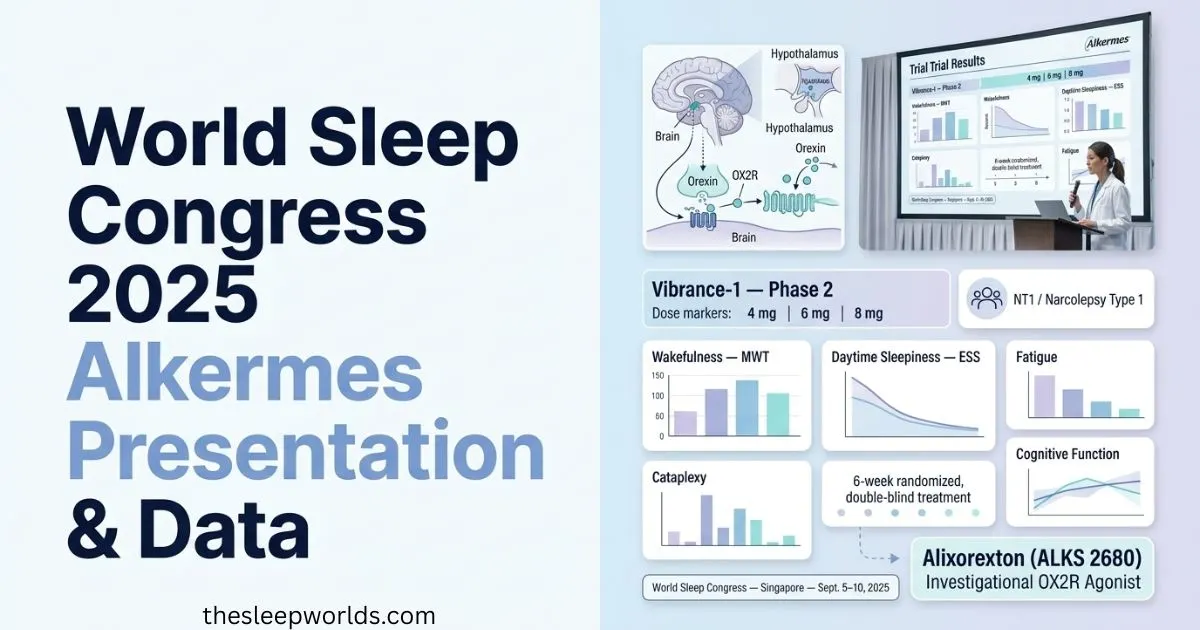
The main Alkermes presentation examined Vibrance-1, a randomized, double-blind, placebo-controlled Phase 2 study involving 92 adults with narcolepsy type 1. Participants received once-daily oral alixorexton at 4 mg, 6 mg or 8 mg, or placebo during a six-week double-blind treatment period.
The primary endpoint was change in mean sleep latency on the Maintenance of Wakefulness Test. Baseline mean sleep latency was only about three minutes across the study population. At Week 6, the observed mean sleep latency was approximately 24 minutes with 4 mg, 26 minutes with 6 mg and 28 minutes with 8 mg, compared with roughly two minutes for placebo.
Vibrance-1 study design
Vibrance-1 enrolled adults aged 18 through 70 with narcolepsy type 1, residual excessive daytime sleepiness and cataplexy. The study used a one-to-one-to-one-to-one randomization design across placebo and three alixorexton dose groups.
Participants first completed the six-week randomized double-blind treatment period. An optional open-label extension then allowed participants to receive alixorexton, beginning at 6 mg with dose adjustment during the initial portion of the extension. The study evaluated wakefulness, sleepiness, cataplexy, narcolepsy severity, fatigue, cognition and treatment-emergent adverse events.
World Sleep Congress 2025 Alkermes Presentation: Improvement in the Severity of Narcolepsy Symptoms and Fatigue
A second oral presentation examined broader narcolepsy symptoms and fatigue. Beyond the primary wakefulness endpoint, the Vibrance-1 program evaluated patient-reported outcomes intended to capture the broader burden of narcolepsy, including daytime sleepiness, cataplexy, hallucinations, sleep paralysis and disturbed nighttime sleep.
The presentation reported improvements in narcolepsy symptom severity and fatigue with alixorexton. The findings were relevant because narcolepsy affects more than the ability to remain awake: patients can experience cataplexy, cognitive difficulties, fatigue and other symptoms that interfere with work, education, relationships and everyday activities.
Epworth Sleepiness Scale results
The Epworth Sleepiness Scale was a key secondary endpoint. Participants entered the study with a mean ESS score of approximately 18.5, reflecting substantial excessive daytime sleepiness. At Week 6, the least-squares mean change was approximately −9.6 with 4 mg, −11.8 with 6 mg and −11.4 with 8 mg, compared with −3.1 with placebo.
The differences versus placebo were statistically significant for all three doses. Alkermes also reported that improvements appeared as early as Week 2 and were sustained through the available Week 13 open-label-extension data snapshot, although the extension data were not based on the full randomized population.
Cataplexy findings
Cataplexy was another important measure in Vibrance-1. The Week 6 weekly cataplexy rate was lower numerically in each alixorexton group than in the placebo group. The reported rate ratio versus placebo was 0.49 for 4 mg, 0.31 for 6 mg and 0.64 for 8 mg.
The 6 mg group showed a statistically significant difference on the prespecified analysis, while the 4 mg and 8 mg comparisons did not reach statistical significance after the study’s multiplicity adjustment. This distinction is important when interpreting the results because not every numerical improvement demonstrated statistical significance.
World Sleep Congress 2025 Alkermes Presentation: Improvement in Patient-reported Cognitive Functioning
The third oral presentation focused on patient-reported cognitive functioning. Cognitive complaints can be an important part of the burden experienced by people with narcolepsy, particularly when excessive daytime sleepiness makes concentration, memory, word finding and problem-solving more difficult.
Vibrance-1 therefore included the British Columbia Cognitive Complaints Inventory and related patient-reported measures. Alkermes reported improvements in perceived cognitive functioning alongside improvements in wakefulness and fatigue, providing a broader picture of the potential effects observed during the Phase 2 study.

Cognitive functioning and fatigue
The cognitive and fatigue analyses were exploratory or secondary measures rather than the primary endpoint of Vibrance-1. The distinction matters because these measures help characterize the patient experience but do not by themselves establish clinical efficacy for every symptom of narcolepsy.
The World Sleep presentation therefore positioned alixorexton as a treatment being investigated across several dimensions of narcolepsy, including excessive daytime sleepiness, wakefulness, fatigue and cognition. The results supported further clinical development but did not establish regulatory approval.
World Sleep Congress 2025 Alkermes Presentation: Poster Presentation for Vibrance-3
Alongside the three Vibrance-1 oral presentations, Alkermes presented a poster describing the design and methods of Vibrance-3. This Phase 2 study was designed to evaluate alixorexton against placebo in adults with idiopathic hypersomnia.
The Vibrance-3 poster was presented on September 9, 2025, as poster board 169. Unlike the Vibrance-1 presentations, this poster primarily described the study design rather than reporting a completed efficacy dataset.
Idiopathic hypersomnia
Idiopathic hypersomnia is a central disorder of hypersomnolence characterized by excessive sleepiness that can persist despite apparently adequate or prolonged sleep. Developing treatments that target wakefulness mechanisms is therefore an important area of sleep-medicine research.
Alixorexton was being studied beyond narcolepsy type 1 because the orexin system plays a major role in stabilizing wakefulness. Vibrance-3 was intended to investigate whether an OX2R agonist could improve symptoms in adults with idiopathic hypersomnia.
World Sleep Congress 2025 Alkermes Presentation: Oral presentations
The three oral presentations were grouped within the World Sleep 2025 session “Targeting the orexin pathway: Emerging pharmacotherapies for narcolepsy type 1.” The session took place on September 8, 2025, in Singapore.
Giuseppe Plazzi presented the main Vibrance-1 study and the patient-reported cognitive-functioning analysis. Yves Dauvilliers presented the analysis concerning narcolepsy symptom severity and fatigue. The combination allowed the audience to examine the same Phase 2 dataset from several clinically relevant perspectives.
| Presentation | Presenter | Main focus |
| Vibrance-1 Phase 2 study | Giuseppe Plazzi | Efficacy and safety |
| Narcolepsy symptoms and fatigue | Yves Dauvilliers | Symptom severity and fatigue |
| Patient-reported cognitive functioning | Giuseppe Plazzi | Cognitive complaints |
| Vibrance-3 poster | Marcus Yountz | Idiopathic hypersomnia study design |
The official congress program identified all three oral presentations in the same September 8 session. The Vibrance-3 poster followed on September 9.
World Sleep Congress 2025 Alkermes Presentation: Conference Call and Webcast
Alkermes also hosted an investor webcast and conference call on September 8, 2025, to discuss the World Sleep data. The webcast included accompanying presentation slides covering the Vibrance-1 Phase 2 study.
The investor materials provided additional context around the clinical program, including study design, efficacy endpoints, patient-reported outcomes and safety. This material is useful when researching the conference presentation because it allows readers to distinguish the individual oral presentations from the broader investor interpretation of the dataset.
What the investor presentation showed
The investor presentation described statistically significant improvements in the Maintenance of Wakefulness Test across all three alixorexton doses. The observed Week 6 mean sleep latency values were approximately 24, 26 and 28 minutes for 4 mg, 6 mg and 8 mg, respectively.
The presentation also showed substantial improvements in ESS scores, reductions in weekly cataplexy rates and improvements in exploratory measures of narcolepsy severity, fatigue and cognition. These were Phase 2 findings, so they were intended to inform continued development rather than serve as definitive evidence of regulatory approval.

World Sleep Congress 2025 Alkermes Presentation: Access the Sessions
World Sleep 2025 was held in Singapore from September 5 through September 10, 2025. The World Sleep Society subsequently made recordings and scientific-program materials available through its Learning Center.
Registered attendees receive access to available congress recordings through their World Sleep Society account, while other users can access selected open sessions or purchase broader recording packages. The Learning Center includes oral abstract sessions, symposia and keynote content from the congress.
Finding the Alkermes sessions
Readers looking specifically for the Alkermes material should search the World Sleep 2025 scientific program for “Alixorexton,” “ALKS 2680,” “Vibrance-1” or the presenters’ names. Alkermes Medical Affairs also hosts the company’s World Sleep 2025 presentation materials.
The official Alkermes archive identifies the Vibrance-1 presentation by Giuseppe Plazzi, the narcolepsy-symptoms-and-fatigue presentation by Yves Dauvilliers and the cognitive-functioning presentation by Giuseppe Plazzi. The Vibrance-3 poster is separately identified in the congress materials.
World Sleep Congress 2025 Alkermes Presentation: Watch World Sleep 2025 Sessions
World Sleep Society describes World Sleep 2025 as its largest World Sleep congress at the time, with more than 350 hours of presentation content. The Learning Center includes recordings from courses, keynotes, symposia and oral abstract sessions.
For readers researching the Alkermes presentation specifically, the conference recording can provide context that is not available from a press release alone, including presenter commentary and the sequence in which the clinical findings were discussed. Scientific presentation materials should nevertheless be interpreted alongside the study design and published or regulatory information.
Current status of alixorexton after World Sleep 2025
The World Sleep 2025 presentations were Phase 2 results, but the program has since advanced. In April 2026, Alkermes announced initiation of its Phase 3 Brilliance program evaluating alixorexton in adults with narcolepsy type 1 and narcolepsy type 2.
The Phase 3 program includes three 12-week randomized, double-blind, placebo-controlled studies: two in narcolepsy type 1 and one in narcolepsy type 2. Alkermes currently lists alixorexton as Phase 3 for both NT1 and NT2 and Phase 2 for idiopathic hypersomnia.
Is alixorexton FDA approved?
No. As of the latest Alkermes pipeline information, alixorexton remains investigational. The company states that it is being evaluated in Phase 3 studies for narcolepsy type 1 and type 2 and in Phase 2 development for idiopathic hypersomnia.
In January 2026, the FDA granted alixorexton Breakthrough Therapy designation for narcolepsy type 1 based on Phase 1 and Phase 2 data. Breakthrough Therapy designation is a development and regulatory designation; it is not the same as FDA approval and does not establish that the drug is safe or effective for routine clinical use.
Conclusion
The World Sleep Congress 2025 Alkermes presentation centered on detailed Phase 2 findings for alixorexton in narcolepsy type 1. The Vibrance-1 dataset involved 92 participants and evaluated once-daily 4 mg, 6 mg and 8 mg doses against placebo over six weeks.
The presentations covered the primary Maintenance of Wakefulness Test endpoint as well as excessive daytime sleepiness, cataplexy, narcolepsy symptom severity, fatigue and patient-reported cognitive functioning. Alkermes also presented the design of Vibrance-3 for idiopathic hypersomnia.
The most important current context is that these 2025 results did not represent an approved treatment. Alixorexton has subsequently moved into Phase 3 development through the Brilliance program, and Alkermes continues to describe it as investigational. Therefore, World Sleep 2025 should be viewed as an important clinical-development milestone rather than a regulatory approval event.
FAQ
What did Alkermes present at World Sleep Congress 2025?
Alkermes presented three oral analyses from the Vibrance-1 Phase 2 study of alixorexton in narcolepsy type 1 and one poster describing the Vibrance-3 Phase 2 study design in idiopathic hypersomnia.
What is alixorexton?
Alixorexton, formerly known as ALKS 2680, is an investigational oral selective orexin 2 receptor agonist being developed by Alkermes for narcolepsy type 1, narcolepsy type 2 and idiopathic hypersomnia.
What was the Vibrance-1 study?
Vibrance-1 was a randomized, double-blind, placebo-controlled Phase 2 study involving 92 adults with narcolepsy type 1. It evaluated once-daily alixorexton at 4 mg, 6 mg and 8 mg against placebo.
What was the primary endpoint of Vibrance-1?
The primary endpoint was change from baseline in mean sleep latency on the Maintenance of Wakefulness Test at Week 6.
What were the MWT results?
At Week 6, observed mean sleep latency was approximately 24 minutes with 4 mg, 26 minutes with 6 mg and 28 minutes with 8 mg, compared with approximately two minutes with placebo.
What happened to Epworth Sleepiness Scale scores?
Alixorexton produced statistically significant improvements versus placebo at all three tested doses. The reported least-squares mean differences versus placebo were approximately −6.4 for 4 mg, −8.7 for 6 mg and −8.3 for 8 mg.
Did alixorexton reduce cataplexy?
The Phase 2 data showed numerical reductions in weekly cataplexy rates across the alixorexton groups. The 6 mg dose demonstrated a statistically significant rate-ratio comparison versus placebo in the prespecified analysis, while the 4 mg and 8 mg comparisons were not statistically significant after multiplicity adjustment.
What was the Vibrance-3 presentation?
Vibrance-3 was presented as a Phase 2 randomized, placebo-controlled study design for adults with idiopathic hypersomnia. The poster focused on study methods rather than final efficacy results.
Who presented the Alkermes data at World Sleep 2025?
Giuseppe Plazzi presented the main Vibrance-1 study and cognitive-functioning analysis. Yves Dauvilliers presented the narcolepsy-symptom and fatigue analysis. Marcus Yountz presented the Vibrance-3 poster.
When did Alkermes present at World Sleep 2025?
The three Vibrance-1 oral presentations took place on September 8, 2025, during the “Targeting the orexin pathway: Emerging pharmacotherapies for narcolepsy type 1” session. The Vibrance-3 poster was presented on September 9, 2025.
Is alixorexton approved by the FDA?
No. As of the latest 2026 Alkermes pipeline information, alixorexton remains investigational. It is being evaluated in Phase 3 studies for narcolepsy type 1 and type 2 and Phase 2 for idiopathic hypersomnia.
What happened to alixorexton after World Sleep 2025?
Alkermes initiated the Phase 3 Brilliance program in April 2026 for narcolepsy type 1 and type 2. The program consists of three 12-week randomized, double-blind, placebo-controlled studies.
Related Articles

Ryan Foster is a curious and dedicated professional with an interest in digital content, lifestyle, and online research. He enjoys exploring useful ideas, learning about new topics, and sharing practical information with others. Ryan values continuous learning, creativity, and building meaningful connections through the digital world.



2 Comments