
World Sleep Congress 2025 Singapore Conference, Research & Key Highlights
World Sleep Congress 2025 was held in Singapore from September 5–10, 2025, bringing together sleep physicians, researchers, scientists, clinicians, and other professionals from around the world. Organized under the World Sleep Society, the congress covered sleep medicine, sleep science, circadian biology, neurological sleep disorders, sleep technology, clinical research, and emerging treatments.
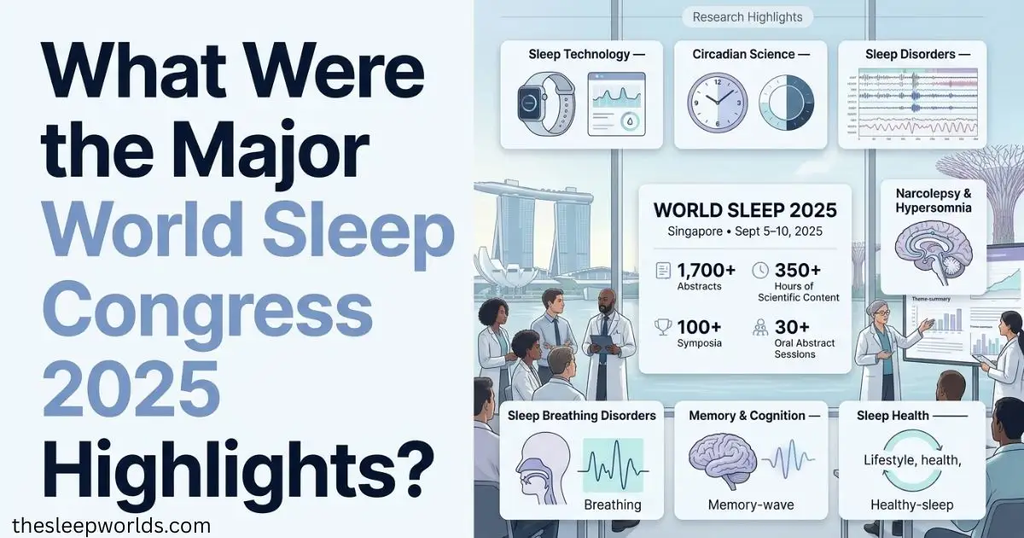
The 2025 meeting featured more than 350 hours of scientific content, including keynote presentations, symposia, oral abstract sessions, postgraduate courses, and poster presentations. The event was also notable for new research into narcolepsy, orexin biology, hypersomnolence, sleep disorders, and emerging pharmacological treatments.

What Was World Sleep Congress 2025?
World Sleep Congress 2025 was a major international scientific meeting focused on the latest developments in sleep medicine and sleep science. It took place in Singapore between September 5 and September 10, 2025.
The congress brought together researchers and healthcare professionals working across clinical sleep medicine, neuroscience, sleep disorders, circadian rhythms, respiratory sleep medicine, behavioral sleep medicine, and related scientific fields.
World Sleep Congress 2025 Location and Dates
| Detail | Information |
| Event | World Sleep 2025 |
| Location | Singapore |
| Dates | September 5–10, 2025 |
| Organizer | World Sleep Society |
| Focus | Sleep medicine and sleep science |
| Scientific content | 350+ hours |
| Courses | 24 |
| Keynotes | 12 |
| Symposia | 100+ |
| Oral abstract sessions | 30+ |
The World Sleep Society described World Sleep 2025 as its largest World Sleep meeting to date, with a scientific program covering a broad range of sleep science and medicine.
When Was World Sleep Congress 2025 Held?
World Sleep Congress 2025 was held from Friday, September 5, through Wednesday, September 10, 2025, in Singapore.
The six-day program combined educational courses with scientific presentations, symposia, keynote lectures, oral abstracts, and poster sessions.
Why Singapore Was Important for World Sleep 2025
Singapore provided an international setting for researchers and clinicians from different regions to exchange findings and discuss developments in sleep medicine.
The congress program reflected the interdisciplinary nature of modern sleep science, connecting clinical medicine with neuroscience, basic science, translational research, and professional education.
What Topics Were Covered at World Sleep Congress 2025?
World Sleep Congress 2025 covered a wide range of subjects related to sleep and circadian health.
Major areas included:
- Sleep disorders
- Narcolepsy
- Idiopathic hypersomnia
- Sleep apnea
- Circadian rhythm disorders
- Insomnia
- Parasomnias
- Pediatric sleep medicine
- Sleep and neurological disease
- Sleep and mental health
- Orexin biology
- Sleep pharmacology
- Sleep research
- Clinical sleep medicine
- Basic and translational sleep science
The breadth of the program illustrates how sleep medicine now intersects with neurology, psychiatry, pulmonology, neuroscience, pharmacology, and other medical disciplines.
How Many Presentations Were at World Sleep Congress 2025?
The World Sleep Society reported that the 2025 congress included more than 350 hours of presentation content. The Learning Center provides access to recordings and materials from the event.
The program included:
- 24 courses
- 12 keynote presentations
- 100+ symposia
- 30+ oral abstract sessions
This made the meeting a substantial source of continuing education and new research findings for sleep professionals.
What Were the Major World Sleep Congress 2025 Highlights?
One important research area at World Sleep 2025 was the development of new treatments targeting the orexin system, particularly for narcolepsy.
For example, Alkermes presented detailed Phase 2 data from its Vibrance-1 study evaluating alixorexton, an investigational oral orexin 2 receptor agonist, in people with narcolepsy type 1. The company presented the findings in three oral presentations.
Other scientific sessions covered a much broader range of sleep disorders and sleep-health research.
Narcolepsy and Orexin Research
The orexin system was a notable area of interest because orexin signaling plays an important role in maintaining wakefulness.
At World Sleep 2025, Alkermes presented research on alixorexton, formerly called ALKS 2680, in patients with narcolepsy type 1. The treatment remained investigational and was not an approved treatment based on these Phase 2 findings.
What Was the Vibrance-1 Study Presented at World Sleep 2025?
The Vibrance-1 study was a randomized, placebo-controlled Phase 2 trial involving 92 patients with narcolepsy type 1.
Participants received once-daily alixorexton at doses of 4 mg, 6 mg, or 8 mg, or placebo, during a six-week double-blind treatment period. The primary endpoint was change in mean sleep latency on the Maintenance of Wakefulness Test (MWT) at Week 6.
What Did the Vibrance-1 Results Show?
According to Alkermes, the three alixorexton dose groups demonstrated statistically significant improvements in mean sleep latency compared with placebo.
At Week 6, observed mean sleep latency was approximately:
| Treatment | Mean Sleep Latency |
| Placebo | ~2.3 minutes |
| Alixorexton 4 mg | ~24 minutes |
| Alixorexton 6 mg | ~26 minutes |
| Alixorexton 8 mg | ~28 minutes |
The reported least-squares mean differences versus placebo were 22.2 minutes for 4 mg, 24.1 minutes for 6 mg, and 26.0 minutes for 8 mg.
These results were reported by the company as clinically meaningful and statistically significant. Because this was a Phase 2 investigational study, the findings should be interpreted as clinical-trial evidence rather than proof of an approved treatment.
What Was Presented About Fatigue and Cognitive Function?
World Sleep Congress 2025 also featured two additional oral presentations from the Vibrance-1 study.
One evaluated changes in narcolepsy symptom severity and fatigue, while another examined patient-reported cognitive functioning in people with narcolepsy type 1 treated with alixorexton.
The reported exploratory outcomes included measures such as the PROMIS-Fatigue scale and the British Columbia Cognitive Complaints Inventory (BC-CCI).
Alkermes reported statistically significant improvements compared with placebo in disease severity, fatigue, and cognitive impairment measures at Week 6.
Why Cognitive Function Matters in Narcolepsy
Narcolepsy can affect more than daytime sleepiness. People may also experience fatigue, difficulty concentrating, memory complaints, cataplexy, sleep paralysis, and other symptoms.
For this reason, research measuring patient-reported cognition and fatigue can provide information beyond the traditional assessment of daytime sleepiness.
What Was Vibrance-3 at World Sleep Congress 2025?
Another Alkermes presentation at World Sleep 2025 focused on Vibrance-3, a Phase 2 study evaluating alixorexton in people with idiopathic hypersomnia (IH).
The poster described the study design and methods for a randomized, placebo-controlled, parallel-group clinical trial. It was presented on September 9, 2025, as poster board 169.
The study was designed to evaluate the safety and efficacy of alixorexton compared with placebo in people with idiopathic hypersomnia.

How Many Alkermes Presentations Were at World Sleep 2025?
Alkermes announced three oral presentations and one poster presentation at World Sleep 2025.
The three oral presentations were:
- Vibrance-1: A Randomized Phase 2 Study Evaluating Safety and Efficacy of the Orexin 2 Receptor Agonist Alixorexton in Patients with Narcolepsy Type 1
- Improvement in the Severity of Narcolepsy Symptoms and Fatigue in Patients with Narcolepsy Type 1 Treated with Alixorexton
- Improvement in Patient-reported Cognitive Functioning in Patients with Narcolepsy Type 1 Treated with Alixorexton
The poster focused on the Vibrance-3 idiopathic hypersomnia study design and methods.
When Were the Alkermes Presentations Held?
The three oral presentations were scheduled for September 8, 2025, during the session titled “Targeting the orexin pathway: Emerging pharmacotherapies for narcolepsy type 1.”
The session was scheduled from 3:15–4:46 p.m. Singapore Time. The Vibrance-3 poster was presented on September 9, 2025, from 4:45–5:45 p.m. Singapore Time.
Was Alixorexton Approved at World Sleep Congress 2025?
No. Alixorexton was an investigational medicine, not an approved treatment based on the World Sleep 2025 data.
Alkermes described alixorexton as a novel investigational oral selective orexin 2 receptor (OX2R) agonist being developed for narcolepsy type 1, narcolepsy type 2, and idiopathic hypersomnia.
Clinical-trial results can provide important evidence about safety and efficacy, but Phase 2 findings do not by themselves establish regulatory approval.
How Can You Watch World Sleep Congress 2025 Sessions?
The World Sleep Society’s Learning Center provides recordings from World Sleep 2025. The Society says the collection contains 350+ hours of content, including keynote presentations, symposia, oral abstract sessions, and courses.
Registered attendees received complimentary access through their World Sleep Society account. Other users can purchase available sessions or bundles through the Learning Center.
Official World Sleep 2025 sessions: World Sleep Society Learning Center
What Made World Sleep Congress 2025 Significant?
World Sleep 2025 brought together multiple branches of sleep science and medicine under one international scientific program.
Its importance came from the combination of:
- New clinical-trial data
- Basic sleep science
- Translational research
- Clinical education
- Emerging pharmacotherapies
- Neurological sleep disorders
- Sleep and circadian research
- International collaboration
The World Sleep Society described the 2025 congress as its largest World Sleep meeting and emphasized the diversity of its scientific program.
World Sleep Congress 2025 and Narcolepsy Research
Narcolepsy was one of the notable areas of research at the congress, particularly research targeting the orexin pathway.
Orexin, also called hypocretin, is involved in regulating wakefulness and sleep. Loss of orexin signaling is strongly associated with narcolepsy type 1, making the pathway an important target for drug development.
The alixorexton data presented by Alkermes represented one example of how researchers are investigating new approaches to restoring or enhancing wake-promoting signaling.
World Sleep Congress 2025 Scientific Program
The World Sleep 2025 scientific program included presentations spanning clinical and fundamental areas of sleep research.
The official congress history describes keynote lectures, scientific symposia, oral and poster abstract sessions, and postgraduate and continuing-education courses.
This broad structure allowed attendees to explore both established clinical practices and emerging scientific discoveries.
Key Scientific Areas
The scientific program included research involving:
- Sleep and circadian biology
- Sleep disorders
- Neurology
- Respiratory sleep medicine
- Pharmacological treatments
- Hypersomnolence
- Narcolepsy
- Insomnia
- Pediatric sleep
- Sleep-related neurological conditions
- Translational sleep research
World Sleep Congress 2025 vs World Sleep Day
World Sleep Congress and World Sleep Day are related to the World Sleep Society but are different events.
World Sleep Congress is a scientific and professional meeting featuring research presentations, education, clinical discussions, and scientific sessions.
World Sleep Day is an annual public-awareness campaign focused on the importance of healthy sleep and sleep health.
World Sleep Congress 2025 took place in Singapore in September 2025, whereas World Sleep Day 2025 took place earlier in the year.
What Happened After World Sleep Congress 2025?
Research presented at a scientific congress can continue to develop after the meeting through additional clinical trials, publications, regulatory decisions, and follow-up studies.
For alixorexton, the World Sleep 2025 data represented Phase 2 development. The subsequent development program became part of the company’s later clinical work in narcolepsy and idiopathic hypersomnia.
Therefore, World Sleep 2025 should be viewed as a snapshot of the sleep-research landscape at that point in time rather than the final outcome of every study presented.
World Sleep Congress 2025: Key Facts
| Question | Answer |
| Where was World Sleep 2025 held? | Singapore |
| When was it held? | September 5–10, 2025 |
| Who organized it? | World Sleep Society |
| How much content was available? | 350+ hours |
| How many courses? | 24 |
| How many keynotes? | 12 |
| How many symposia? | 100+ |
| Oral abstract sessions | 30+ |
| Major research area | Sleep science and medicine |
| Notable drug-development topic | Orexin 2 receptor agonists |
| Notable Alkermes study | Vibrance-1 |
| Investigational drug | Alixorexton (ALKS 2680) |
Conclusion
World Sleep Congress 2025 was held in Singapore from September 5–10, 2025, bringing together an international community of sleep researchers, clinicians, and healthcare professionals. The congress featured more than 350 hours of scientific content, including 24 courses, 12 keynote presentations, more than 100 symposia, and 30+ oral abstract sessions.
One notable area of the 2025 meeting was emerging treatment research for narcolepsy and hypersomnolence. Alkermes presented Phase 2 Vibrance-1 results for the investigational orexin 2 receptor agonist alixorexton, along with research into fatigue, cognition, and narcolepsy symptoms.
The congress also demonstrated the breadth of modern sleep medicine, from basic sleep biology and circadian science to clinical disorders, emerging therapies, and continuing medical education.
FAQs
What was World Sleep Congress 2025?
World Sleep Congress 2025 was an international sleep medicine and sleep science congress held in Singapore from September 5–10, 2025.
Where was World Sleep Congress 2025 held?
The congress was held in Singapore.
When was World Sleep Congress 2025?
World Sleep 2025 took place from September 5 through September 10, 2025.
Who organized World Sleep Congress 2025?
The event was organized under the World Sleep Society, the international organization focused on sleep health, sleep medicine, and sleep science.
How many presentations were at World Sleep 2025?
The World Sleep Society reported 350+ hours of content, including 12 keynote presentations, 100+ symposia, 30+ oral abstract sessions, and 24 courses.
What was the biggest research focus at World Sleep 2025?
The congress covered many research areas rather than one single topic. Narcolepsy, orexin biology, sleep disorders, clinical sleep medicine, and emerging therapies were among the notable areas represented in the program.
What is Alixorexton?
Alixorexton, formerly called ALKS 2680, is an investigational oral selective orexin 2 receptor agonist developed by Alkermes for sleep-wake disorders including narcolepsy and idiopathic hypersomnia. It was investigational rather than an approved treatment at World Sleep 2025.
What was the Vibrance-1 study?
Vibrance-1 was a randomized, placebo-controlled Phase 2 study evaluating alixorexton in 92 patients with narcolepsy type 1. The study evaluated wakefulness and other outcomes over a six-week double-blind treatment period.
Can I watch World Sleep 2025 presentations?
Yes. The World Sleep Society’s Learning Center provides recordings and other content from the 2025 congress. Registered attendees have access through their accounts, while other users can purchase available sessions or bundles.
Related Articles

Ryan Foster is a curious and dedicated professional with an interest in digital content, lifestyle, and online research. He enjoys exploring useful ideas, learning about new topics, and sharing practical information with others. Ryan values continuous learning, creativity, and building meaningful connections through the digital world.